
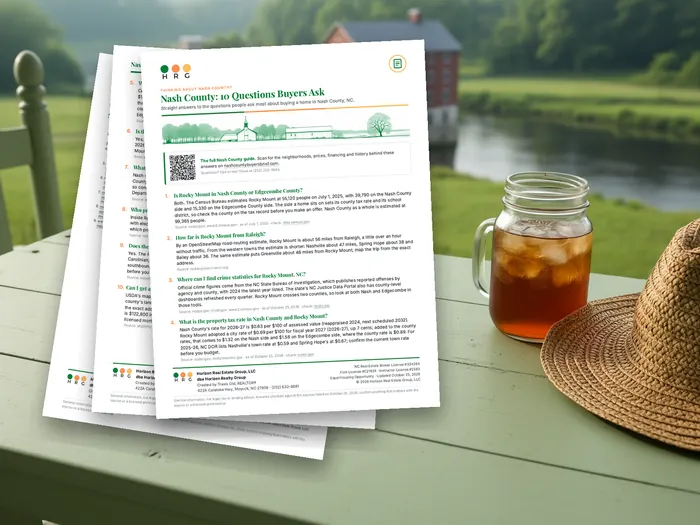
Where Nash County Buyers Land, Town by Town

In this post
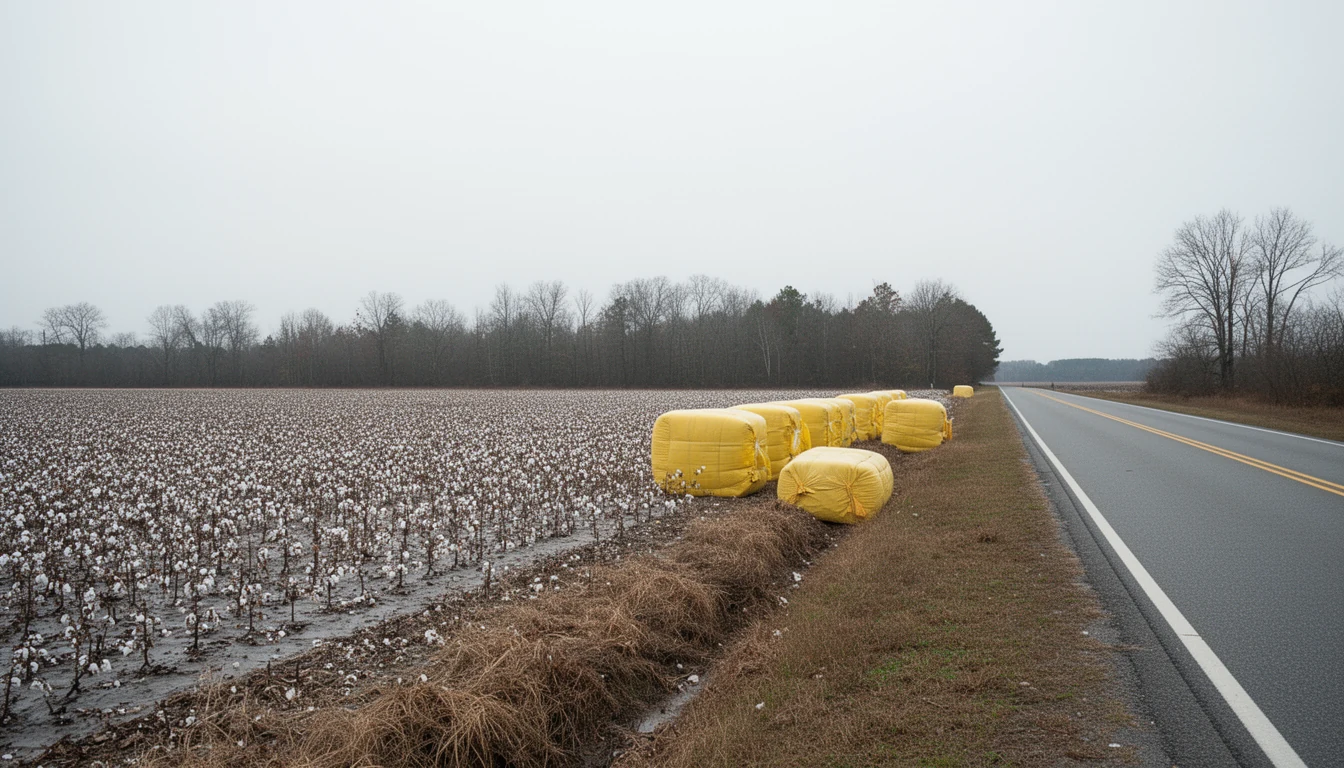
The cotton is off the fields west of Rocky Mount now. What’s left is gray stubble and yellow plastic sleeves around the modules stacked at the field edges. The sky in late October sits flat over US-64 all the way to the Wake County line.
I drive that road most weeks. Somewhere past the Nashville exit, where the four-lane straightens and the land opens up, the question buyers ask me changes. It stops being how much house and becomes which town. Those are two different questions, and the second one is harder.
In a lot of counties you pick a town and then go find a house in it. Here the town picks a decade for you. Nash County’s places were built by different industries in different generations, and the housing stock still says so out loud, block by block.
Two lines drew this county
The county came out of Edgecombe in 1777. The first courthouse went up in 1778 on ground the town of Nashville still occupies, back when the place was called Nash Court House by Peach Tree Creek. A post office followed in 1805. Nashville incorporated in 1815, the first town in the county to do it.
Then came the line that explains almost everything else. In 1871 the boundary between Nash and Edgecombe was moved off the Tar River and onto the Wilmington and Weldon Railroad tracks. That is why Rocky Mount has two tax bills and, since 2024, two school systems. The line is still there. You can stand on it.
West of Rocky Mount, the railroad did the town-building. A spur ran 25 miles west from Rocky Mount in 1886 and Spring Hope grew at the end of it. By 1910 the next lines had reached the far side of the county, and Middlesex and Bailey both date to 1908 because of them.
So the county has a sequence: a river county seat from the 1770s, a railroad city on the fall line, a railroad town from 1886, two more from 1908, and now a growth ring of new construction where the fields meet the city. Each one asks a different thing of a buyer.
Rocky Mount, west of the tracks
Start with the city, because most buyers do. Everything west of the tracks is Nash County: the older blocks around downtown, the avenues, the mid-century neighborhoods along Sunset Avenue, and the newer subdivisions up Wesleyan Boulevard.
The housing runs from 1920s bungalows and foursquares in Villa Place and West Haven to post-war ranches and split-levels around Englewood and out toward City Lake. Benvenue and Winstead Avenue sit in between, and the north side carries the newer stock and N.C. Wesleyan University.
This is where the inventory is. If you need to be in a house in sixty days, the Nash side of Rocky Mount is usually the only part of the county that can promise you a choice.
It is also the oldest stock in the county, and old houses in this market come with a known list: two-wire circuits with no ground, galvanized supply lines that have already been patched, pier-and-beam floors that move with the clay, and one-bath floor plans that no longer match how people live. None of that is a reason to walk away. All of it is a reason to inspect before you fall for a porch.
One more thing on the city. The July 1, 2024 school demerger moved roughly 1,700 Rocky Mount students into Edgecombe County schools, and the county line became the district line. An address two blocks one way and an address two blocks the other way are now in different systems. Check the assignment for the specific house, not for the town.
I’ve written about the Nash side and the Mills district on their own. This piece is about the places outside the city, where most of the county actually lives.
Nashville: the square, and what grew around it
Nashville is the county seat, and it looks it. The courthouse on Washington Street, between Drake and North Court, went up in 1921 in the Colonial Revival style and landed on the National Register in 1979. Town Hall is a few blocks away at 499 South Barnes Street.
The houses closest to that square are the ones I like best in the county. They date from roughly 1900 to the 1940s: brick and weatherboard, deep porches, lots that were platted when a family needed room for a garden and a shed. Walk four blocks off the square in any direction and you can read the town’s whole growth in the trim.
Outside that ring, Nashville turns into the county’s new-construction market. Subdivisions have filled in along the US-64 frontage, and the pace has been steady for years. That is where a buyer who wants a 2019 floor plan and a two-car garage actually ends up.
The catch is size. Nashville has 5,632 people at the 2020 census, and a town that size does not carry forty houses for sale at once. You wait for the right one, or you widen the map.
Who fits here: county employees, hospital staff who want fifteen minutes to UNC Health Nash, and families who want the county schools without living out in the country. What to check: whether the lot is inside town limits, because water and sewer follow that line and nothing else, and whether an older house’s addition was permitted or just built.
Spring Hope: the best-preserved railroad town here
If you only have time for one of the small towns, drive Spring Hope.
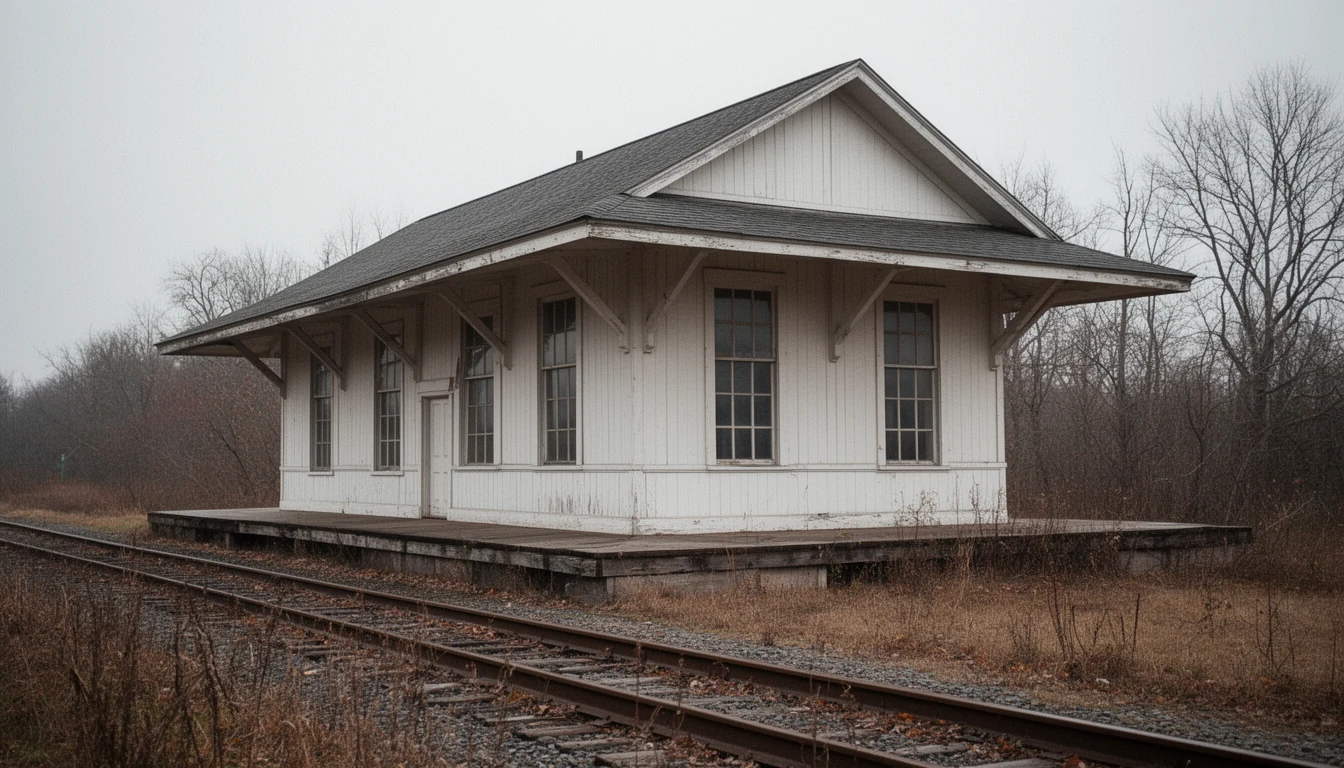
The railroad built it and the railroad left it a gift. The 1888 passenger and freight depot still stands on its original site on Main Street, board-and-batten and unpainted-looking in the right light, and the town library operates out of it now. Main Street’s south side is a continuous row of one- and two-story brick commercial buildings, most of them finished by the early 1900s. The Citizens Bank building at 115-117 West Main went up in 1908 with an arcaded Neo-Classical front. Two doors down, the Finch Building at 127 West Main carries a sixty-foot facade and anchors the west end of the block.
The town was rich once, and not shy about it. In the 1910s about 10,000 bales of cotton a season moved out of Spring Hope, which a local historian ranked as the state’s leading inland exporter. Population went from 500 in 1900 to about 1,500 by 1914. The merchants built on East Nash, East Branch, and South Walnut in Queen Anne and Neo-Classical Revival, and the lumber mill built plainer worker cottages on West Nash. Three of those cottages still stand at 208, 212, and 302 West Nash Street.
About 200 buildings in that core were listed as a National Register district in 1988, and the first weekend in October the whole thing fills up for the National Pumpkin Festival. This year the parade ran down Main Street on October 3.
For a buyer, Spring Hope means one thing: you are shopping 1900 to 1930. That is a different inspection than a 1998 subdivision house. Knob-and-tube wiring hides in walls that were never opened. Plaster cracks over lath that has been moving for a century. A house with one bathroom was designed for a family that had different expectations. Porch floors and pier foundations take the weather first. And on a house that has been renovated, ask what happened to the original siding, because vinyl over historic trim is a decision somebody made once and you will live with.
In exchange, the trees on those streets were planted before your grandparents were born, and the town is small enough that the people at the post office learn your name by the second month.
Bailey and Middlesex: the 1908 towns
Both of these came off the same wave. The rail lines that crossed the western county by 1910 created Middlesex and Bailey in 1908, and both still read as railroad grids: a few blocks of streets, a main crossing, houses set close to the sidewalk.
Bailey is the smaller footprint at 0.7 square miles. The Morgan School, listed on the National Register in 2006, is the landmark that survived. Middlesex has 912 people at the 2020 census across 1.05 square miles, and it is the closest town in the county to Zebulon and the eastern Wake job base, about 32 miles from downtown Raleigh.
The honest limit on both is inventory. These are towns where two or three houses might be for sale in a season, and the house you want may simply not exist this year. If you need to move on a schedule, that is a real constraint, not a preference.
The other limit is errands. Groceries and a hardware store are local. Anything bigger means Rocky Mount, Wilson, or Zebulon, and you should drive that run once at 6 p.m. on a weekday before you decide it’s fine.
The growth ring outside the city limits
North and northwest of Rocky Mount, the county is growing in a ring rather than in a town. Red Oak has 3,342 people and Dortches 1,082, and the unincorporated country between them is where a lot of the county’s new houses have gone in.
This is where buyers land when they want land and a newer house without giving up the drive to work. Pfizer’s Rocky Mount plant is the county’s largest private employer, Cummins runs its engine plant up US-301, and both are minutes from this ring. US-64 and I-95 do the rest.
Two things to sort out early here. First, whether the address is on county water or a well, because that answer changes the inspection and the financing, and it decides how your August goes. Second, septic: a lot that passed a perc test for a three-bedroom may not support the addition you have in mind.
Red Oak and Dortches also sit in fire districts, which is a line item worth understanding before you compare one address to another. Not a reason to avoid the area. A reason to read the whole bill instead of the top line.
How to test a town in one weekend
Drive it on a Tuesday at 7 a.m., not a Saturday at noon. Traffic tells you more about a place than any open house.
Then do four checks, in this order. Look up the school assignment for the exact address. Find the water and sewer line on the county map. Time the grocery run from the driveway. And drive the commute westbound once, at the hour you would actually drive it, because the difference between a good day and a bad one on US-64 is about twenty minutes and it compounds five days a week.
If those four answers work, the house is worth the inspection. If one of them doesn’t, no floor plan fixes it.
Sunday afternoon the light comes in low across the fields and the brick on Main Street goes orange for about an hour. That is the part of this county that sells itself, and it is the same in four different towns.
Pick the decade you want to live in first. The house follows, and it usually follows faster than people expect.
Keep reading
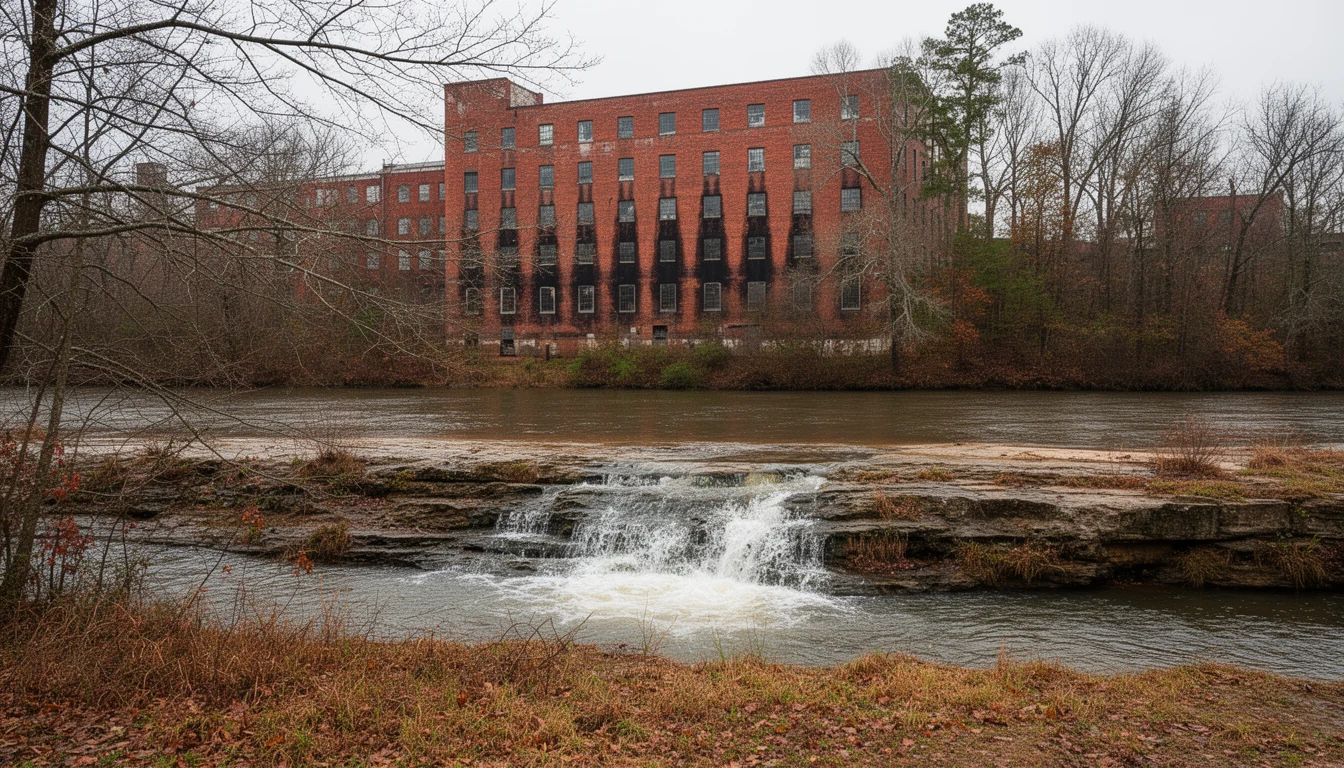
7 Flood-Insurance Mistakes Tar River Buyers Shouldn't Make
Flood insurance on the Tar River: the 30-day wait, the $250,000 cap, contents left off the policy, and a discount Rocky Mount buyers never claim.
Nash County Closing Statement: Reading Every Line
A Nash County closing statement, line by line: excise tax, recording fees, prorated property taxes, and the lines worth questioning before you sign.
Nash County New Builds: Permits and What to Verify
Building in Nash County? Permits and inspections come from Rocky Mount city or the county, depending on the lot. What to verify on a new build.